


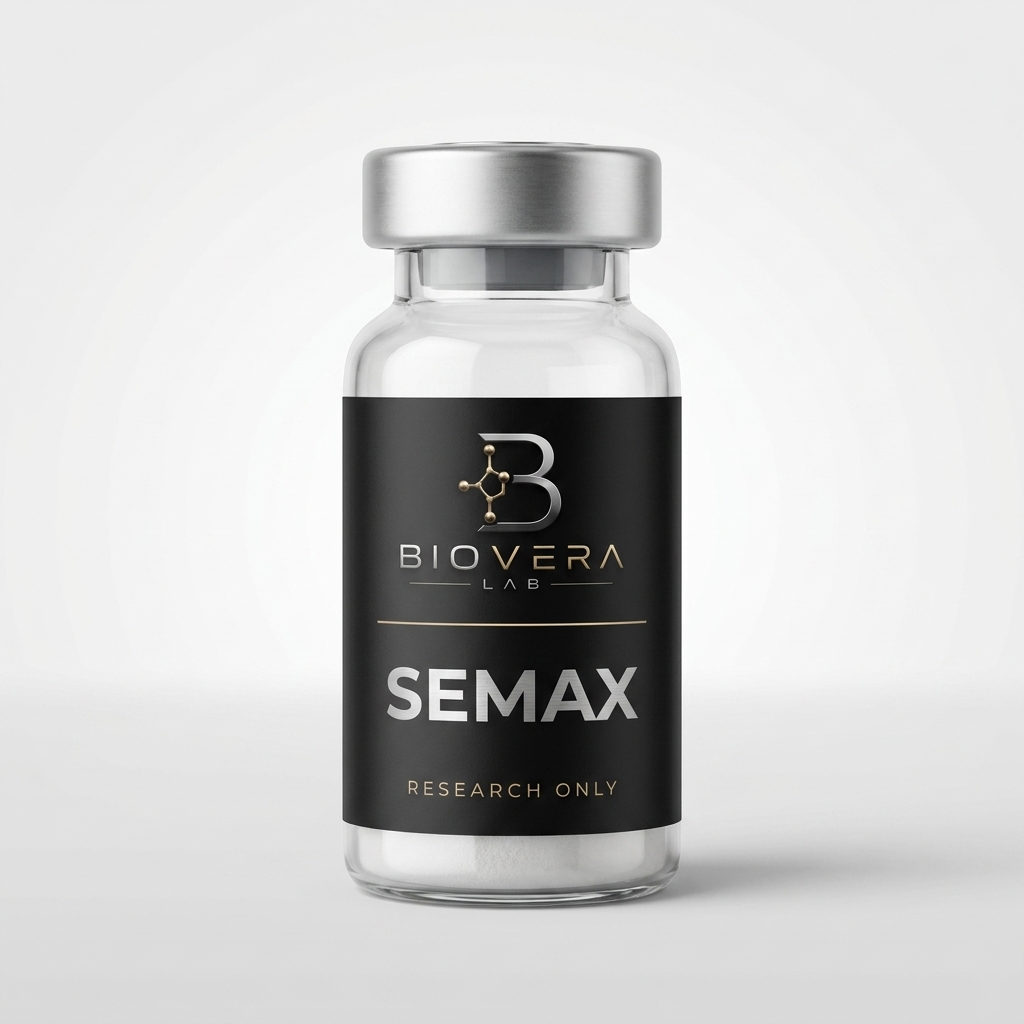
Semax
Semax
BUNDLE & SAVE
Couldn't load pickup availability
Domestic ground, cold-chain packed. International rates at checkout.
Description
Semax, a synthetic peptide developed in the 1980s by Russian researchers, is authorized in Russia and Ukraine for various indications, including ischemic brain stroke, encephalopathy, optic nerve atrophy, and cognitive disorders like dementia. Its potential benefits extend to neurological conditions such as Alzheimer’s, traumatic brain injury (TBI), and stroke.
This peptide, an analog of the ACTH(4-10) peptide derived from adrenocorticotropic hormone (ACTH), is composed of seven amino acids, including a fragment from ACTH (4-7) and a Pro-Gly-Pro fragment. This structure enables Semax to cross the blood-brain barrier, reaching significant concentrations in the central nervous system where it may enhance neuroprotection and cognitive performance. Additionally, modifications like acetylation and amidation lead to the formation of N-Acetyl Semax Amidate, potentially enhancing its stability.
It stimulates neurotrophic factors like Brain-Derived Neurotrophic Factor (BDNF) and Nerve Growth Factor (NGF) in the central nervous system. It also affects serotonin, dopamine, and enkephalin signaling, which could influence mood, stress, cognition, and reward-related behavior. Research indicates that Semax may upregulate both BDNF levels and the corresponding tropomyosin-related kinase B (trkB) receptors in brain cells, vital for cell survival and neuroplasticity.
Despite its promising potential, Semax’s clinical studies are limited, and it lacks FDA review or approval. Side effects, risks, and legal status must be considered before use for research purposes.
Studies demonstrate Semax’s efficacy in various applications. It has been used in treating glaucomatous optic neuropathy in patients with normalized ophthalmic tone and has shown effectiveness in different stages of ischemic stroke. Its nootropic-like activity in humans has been observed, suggesting benefits in cognitive performance, neuroprotection, and mood regulation.
Clinical data indicate Semax’s impact on cognition, with studies showing improved memory test accuracy and changes in the brain’s default mode network, hinting at enhanced information processing and memory capabilities. Its potential in mood regulation is explored, with animal studies suggesting anxiolytic and antidepressant effects under stress.
In terms of neuroprotection, Semax has shown promise in stroke patients, with trials reporting improved motor performance and functional independence. It also exhibits anti-inflammatory properties, potentially aiding in conditions like chronic brain ischemia. Its protective effects against various neurotoxins, including alcohol intoxication and neurotoxins related to Parkinson’s disease, have been noted in clinical and pre-clinical trials. Furthermore, Semax might offer gastroprotective benefits. A study indicated its effectiveness in healing peptic ulcers, with a significantly higher healing rate compared to a placebo. Researchers hypothesize these effects might be due to its influence on blood flow, microcirculation, and vascular permeability, though further research is needed to confirm these mechanisms.
Semax emerges as a multifaceted peptide with potential applications in cognitive enhancement, mood regulation, neuroprotection, and gastroprotection. Its mechanism of action involves interacting with critical neurotrophic factors and neurotransmitters, and it demonstrates promising results in both clinical and pre-clinical studies. Despite its potential, it’s important to approach Semax with an understanding of its limited clinical studies, regulatory status, and potential side effects, especially when considering it for research purposes.
Shipping & returns
- Domestic
- 3–4 business days
- Dispatch
- Same day, orders before 2pm ET
- Packing
- Insulated, cold-chain
- Tracking
- Issued on dispatch
- International
- Rates at checkout
On arrival
Inspect the vial before storing it. Check that the lot number on the label matches the lot number on the Certificate of Analysis in your order. If they do not match, do not use the material — contact us and we will replace it.
Returns
We do not accept returns on opened vials. Once material has left our cold chain we cannot verify how it was stored, and we will not resell a vial whose handling history we cannot account for. That restriction is the point of the brand, not an exception to it.
What we do replace
- Material that arrives damaged, compromised, or with a broken seal.
- A lot number that does not match its Certificate of Analysis.
- An analytical result outside the specification stated on the CoA.
- The wrong compound or the wrong quantity.
Report any of the above within 14 days of delivery with photographs and your order number. Verified claims are replaced or refunded in full, including shipping. We do not argue about this.
Unopened vials
Unopened, unrefrigerated-in-transit vials may be returned within 14 days for a refund less shipping, at our discretion and subject to inspection. Returned material is destroyed, not restocked.
Supplied as a raw material for laboratory research and formulation development. Not for human or veterinary use. Not for resale to consumers as supplied.
Compliance & research use
Research use only
Supplied as a raw chemical for laboratory research and formulation development. Not a drug, supplement, cosmetic, food, or medical device. Not evaluated by the FDA.
Not supplied for
- Human or veterinary use.
- Diagnostic, therapeutic, or cosmetic application.
- Resale to consumers as supplied.
Why there are no claims here
You won't find a mechanism of action on this page. That absence is deliberate. We report what we can measure — identity, purity, mass, sequence — and omit everything we cannot. If you ask us for dosage or administration guidance, we will decline.
Who may purchase
Buyers attest at checkout that they are 21 or older, are purchasing for research or formulation use, and accept full responsibility for safe handling and lawful use. Trade names and INNs are used solely to identify the chemical substance.
For laboratory research and formulation development use only. Not for human or veterinary use. Not a drug, cosmetic, or food. Not for resale to consumers as supplied.

Semax
Values are typical and lot-specific. The figures for your lot are on its Certificate of Analysis. Supplied for laboratory research and formulation development use only.
Tested by a lab that does not work for us
Every lot is analysed by an independent US laboratory before release. Identity, purity and lot authenticity are verified against retention-time and parent-ion mass references. We do not grade our own work.
Representative only. Upload the chromatogram from this lot's certificate to show the real trace.
Results are lot-specific. The certificate above describes the lot you receive, not a representative batch. Retained a minimum of five years and publicly retrievable.
How we know it is what we say it is
Two independent questions have to be answered before a vial leaves the building: is this the right molecule, and how much else is in there. They are answered by different instruments, and both answers ship with the material.
Identity — mass spectrometry. The observed mass is compared against the theoretical mass of the target sequence. A mismatch is a different compound, not a variation.
Purity — reverse-phase HPLC. The main peak is integrated against total peak area. The reported figure is that integration, not a specification we hope to meet.
Lot-matched, not batch-typical. The certificate you receive describes the vial you receive. A representative CoA from a previous lot is not evidence.
Retained and retrievable. Every certificate is QR-resolved and held a minimum of five years, so a result can be produced years after the vial is gone.
Illustrative. The trace for your lot is on its Certificate of Analysis.
From resin to vial
Nothing here is proprietary. It is the standard route, run properly and documented at each step — which is the entire difference between a supplier and a reseller.
Synthesis
Solid-phase peptide synthesis. The sequence is assembled residue by residue on a resin support, then cleaved.
Purification
Preparative reverse-phase HPLC. Truncated and deletion sequences are separated from the target and discarded.
Lyophilization
Freeze-dried to a stable powder cake. No solvent, no carrier, no excipient added.
Lot control
The finished lot is analysed, assigned a number, and tied to its certificate. That number is on the vial you receive.
The paperwork is the product
A buyer sees the website once. They hold the vial every time, and they hold the certificate for years afterwards.
Certificate of Analysis — lot-matched, HPLC purity, identity by mass spectrometry.
Safety Data Sheet — handling, storage and disposal under laboratory conditions.
Identity block — CAS, molecular weight, sequence. A peptide without a CAS and an MW is not a product.
QR-resolved verification — publicly retrievable, retained a minimum of five years.
Supplier traceability — so our paperwork can become part of your safety file.

Keeping it intact
Peptide integrity is lost to heat, light and repeated freeze-thaw long before it is lost to time. Handle accordingly.
Lyophilized, at −20 °C, protected from light. Stable for extended periods in this state.
Performed under laboratory conditions appropriate to the intended research application. Aliquot to avoid repeated freeze-thaw.
Reconstituted material is markedly less stable than lyophilized. Prepare what the work requires.
Dispose of in accordance with local regulations for laboratory chemical waste. See the SDS.
What to ask any supplier
These are the questions a serious buyer asks before the first order. If a supplier cannot answer them in writing, the price is not the relevant variable.
| BioVera Labs | Typical vendor | |
|---|---|---|
| Certificate of Analysis | Lot-matched, per vial | Batch-typical or on request |
| Identity method | Mass spectrometry | Often unstated |
| Purity method | HPLC, integration reported | "≥98%" as a claim |
| CoA retention | 5 years, QR-resolved | Not retained |
| Safety Data Sheet | Ships with every lot | On request |
| Supplier traceability | Documented | Undisclosed |
| Effect claims made | None | Frequent |
Comparison describes documentation practice, not product performance. We make no representation about any other supplier's material.
Literature index
Primary sources, unannotated. We point to the science rather than summarize it into a promise.
Listed for reference only. Inclusion is not a representation about the properties, safety or suitability of this material for any purpose.